
Table of Contents
Having a strong online presence is essential today, but as a therapist, integrative doctor, or local clinic owner, you don’t just serve “the internet”—you serve your community. Sometimes, the fastest way to get found online is to start by getting found offline.
When you pair face-to-face outreach with a smart digital strategy, you create a powerful foundation for your practice. We created this guide to show you why local connections matter, how to make them with confidence, and how to set up your online presence to welcome the people who want to work with you.

What is offline marketing?
Offline marketing refers to any strategy used to build brand awareness and attract new clients outside of the internet—think classic, “old school” marketing and networking. For health and wellness professionals, this typically includes distributing community flyers, building B2B referral partnerships, handing out rack cards, and participating in local events.
Why offline marketing is important
If you’re already investing time in your website and social media, you might wonder whether offline marketing is worth the effort. The short answer? Absolutely. It’s one of the most effective ways to build real trust and human connection.
When you rely solely on your online presence, you are competing with thousands of other voices. Local marketing cuts through the online noise. It builds immediate credibility and proves that you are an active, invested provider in the actual neighborhoods where your patients live and work.
The Power of “Old School” Outreach
We tend to think of modern marketing as a complicated balance of optimizing for ever-changing algorithms and managing complex digital strategy. But the truth is, some of the most reliable ways to build a thriving practice are still rooted in classic, face-to-face community connection. Here are a few examples of offline marketing we suggest you try:
1. Value-Driven Community Flyers
Putting up flyers in local coffee shops, libraries, gyms, and community centers is incredibly effective—if done right.
The biggest mistake practitioners make is treating a flyer like a giant business card that simply says, “Dr. Smith, Naturopath. Call to book.” Instead, your flyer should offer immediate and unique value. If you are a physical therapist, your flyer could say and include, “3 Stretches for Desk Workers.” If you are a therapist, try “A 5-Minute Grounding Exercise for Mid-Day Anxiety.” Give them a reason to stop, read, and trust you.
2. B2B Referrals and Rack Cards
Your best referral sources are often other professionals in your community whose services complement yours:
- Therapists can partner with local acupuncturists, bodyworkers, or primary care doctors.
- Veterinary clinics can partner with local groomers, pet supply stores, or dog trainers.
- Nutritionists can partner with local fitness coaches, personal trainers, or boutique studios.
Create a rack card or a professional referral pad. This is a simple, beautifully branded card that explains exactly who you help, what you treat, and how to refer a patient or client to you. Drop these off in person at complementary practices with a warm, in-person introduction.
3. Showing Up at Local Events
Need branded materials for your next local event?
We design high-quality print materials that reflect your practice’s unique visual style and turn connections into booked appointments.

The Hybrid Secret: Bridging Offline Connections to Online Growth
First, Make Sure Your Website is Ready for Them
Think about consumer behavior. If someone meets you at an event and doesn’t have time to stop and scan your flyer, what is their immediate next step? They are going to go home and Google your name or your specialty.
This is why your online presence must be fully optimized to capture the connections you make in person. Being ready for local search is non-negotiable. At a bare minimum, your NAP (Name, Address, Phone number) must be standardized and identical across your website, your Google Business Profile, and every online directory. If your local SEO is a mess, that warm lead you just shook hands with might accidentally book with a competitor who ranks higher.
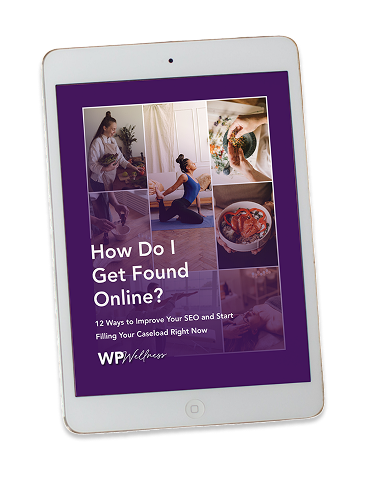
(Not sure if your local SEO is up to par? Our free 12-step guide, How Do I Get Found Online?, shows you exactly how to build clinical authority and show up in local search.
Use QR Codes, and Use Them Right
For the people who do stop to engage with your printed materials, QR codes are the simplest bridge between the physical and digital worlds.
However, the most common mistake practitioners make is putting a QR code on a flyer that simply links to their website’s homepage. If someone is standing in line for coffee and scans your code, they don’t have time to navigate your entire site to find what they need.
Instead, your QR codes should link directly to a specific, highly relevant landing page or a lead magnet.
- At a local 5K race: Your physical therapy booth has a QR code that says, “Scan here to download our free Runner’s Knee Recovery Guide.”
- At a neighborhood coffee shop: Your therapy flyer has a QR code that says, “Scan here to take our free 2-minute Burnout Assessment.”
When they scan the code, they land on a simple, mobile-friendly page where they enter their email address to get the free resource. Now, even if they aren’t ready to book an appointment today, they are safely on your email list, and you own that contact.
Don’t let a confusing or hard-to-navigate website hold back your in-person efforts. Partner with WP Wellness to ensure your online presence is welcoming, clear, and designed to turn those great community connections into booked appointments.
Connecting Real-World Trust to Digital Growth
Local outreach proves that you are an active, invested member of your community. When you combine that real-world trust with a simple and engaging online presence, you bridge the gap between offline relationships and long-term practice sustainability.
Whether you need event print assets, a website refresh, or an email list setup, WP Wellness is ready to partner with you. Our expert team can handle the strategy and execution behind the scenes, giving you precious time back to focus on your clients and your community.
Want to make sure your online presence is ready for all those new in-person connections?
Frequently Asked Questions
How do I track if my printed flyers or QR codes are actually working?
What’s the best way to approach another provider for a referral partnership without feeling “salesy”?
Approach them with a mindset of collaboration, not extraction. Don’t walk in asking for referrals; walk in asking how you can support their patients. Say something like, “I run a nutrition practice down the street, and I see a lot of patients who could benefit from your acupuncture services. I’d love to leave some of my cards here, and grab some of yours so I can refer my clients to you.” It’s a win-win.
Does a lead magnet form linked to a QR code need to be HIPAA compliant?
Where is the best place to put a QR code on my printed materials?
Make it a focal point, not an afterthought. The biggest design mistake is shrinking a QR code and hiding it in the bottom corner of a flyer or business card. Place it prominently, ensure it contrasts sharply with the background so phone cameras can easily read it, and always pair it with a clear, direct instruction (e.g., “Scan with your phone’s camera to get your free guide”).
How often should I follow up with other clinics after dropping off referral cards?